
How to book more qualified B2B sales meetings in 2026
You need more sales meetings. Outreach takes hours. Few prospects reply. And some of the meetings you do book go nowhere.
To book more sales meetings that lead to business, contact companies that have a reason to buy now, give them a small and specific reason to talk, turn every interested reply into a calendar invite the same day, and protect each booking until it happens. More volume helps only after those four work.
KEY TAKEAWAYS
- About 5% of buyers are in the market at once. Target companies with a fresh trigger.
- Book against four tests: fit, person, reason and purpose.
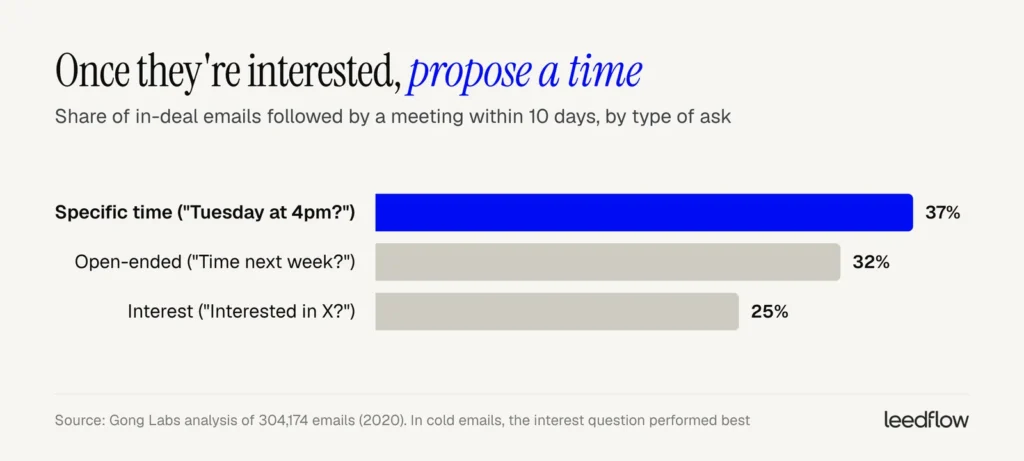
- Ask for interest first and a specific time later (Gong: 37% vs 25% in active deals).
- Answer interested replies the same working day with two specific times.
- Protect each booking: a slot within 5 days, two reminders, a same-day rebook.
Why aren’t you booking more sales meetings?
5 in 100. That’s roughly how many of your potential buyers are ready to buy at any given time, according to the 95:5 rule from John Dawes of the Ehrenberg-Bass Institute (2021). The other 95 aren’t shopping, however good your email is.
So low numbers are normal. The average cold email reply rate was 3.43% in Instantly’s 2026 benchmark of 2025 campaigns, and 5.5% for the top quartile.
It isn’t only you. Only 60% of SDRs hit quota in The Bridge Group’s 2025 survey of 351 B2B companies, the lowest share in the study’s history.
Most teams have two or three of these leaks at once:
| Symptom | Likely cause | First fix |
|---|---|---|
| Almost no replies, not even “no thanks” | Emails land in spam | Bounces under 2% (Instantly), spam complaints under 0.10% (Google) |
| Mostly “not relevant” or “wrong person” | The list is too wide | Tighten your ideal customer profile (ICP) and job titles |
| Polite “not now” replies | No reason to act, or too big an ask | Lead with a trigger, ask for interest |
| Interest, but few meetings | Replies stall | Answer the same day with two times |
| Meetings booked, few held | No-show process | Book sooner, confirm, remind |
What makes a meeting worth booking?
A qualified B2B meeting is a conversation with someone at a company that fits your ideal customer profile, who owns or influences a problem you solve, who has a reason to look at it now, and who has agreed to a clear purpose for the call. When one of those is missing, the meeting rarely turns into a deal.
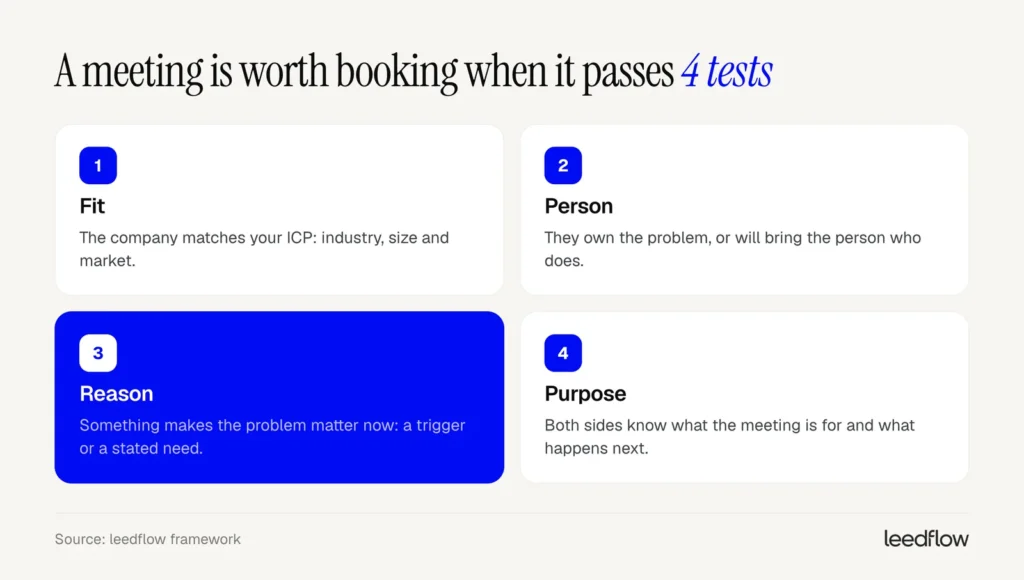
If a prospect fails two of the tests, skip the full meeting. Offer a short call or something useful, and keep them on a nurture list.
The person test needs the most care. If the person who replied doesn’t own the problem, ask them to bring the one who does: “Would it make sense to include [name] from [team]?”
A quality bar means fewer meetings. In the same Bridge Group report, median monthly quotas were 16 held meetings for teams booking introductory meetings and 9 for fully qualified ones.
Count held meetings that pass the tests. A quota on booked meetings with no quality bar rewards reps for booking anyone who says yes.
How to find companies that have a reason to buy
A logistics company in Göteborg posts three job ads for sales reps in the same week. Soon those reps will need lists and a pipeline. The company never said it has a prospecting problem. The job ads did.
That’s a trigger: an event that makes a problem you solve more urgent, and the practical answer to the 95:5 rule.
| Trigger | What it usually makes harder | Where to spot it |
|---|---|---|
| A new leader in the role you sell to | Tools and vendors get reviewed early | LinkedIn job changes, news |
| Hiring for roles your product supports | New people need tools, data and onboarding | Job ads, careers pages |
| A funding round or a new owner | Growth targets arrive before the process | Press releases, funding news |
| Expansion into a new market | No contacts or pipeline there yet | Press releases, local job ads |
| Fast growth or a reorganisation | What worked for a small team breaks | Headcount trends, annual reports |
Three rules for using them:
- Say what the trigger makes harder. Everyone sends “congrats on the round”. Name the problem that tends to follow.
- Act while it’s fresh. A trigger from last week is a reason. One from last year is trivia.
- Stack signals. A new Head of Sales plus three SDR job ads beats either alone.
Then you need verified contacts at those companies. Data accuracy decides how many emails arrive, so compare providers on coverage and accuracy in your market.
Once your ICP and triggers are written down, you can automate most of that prospecting work. In a B2B lead generation platform like leedflow, it’s one filtered search: job title, headcount and country are three of the 60+ filters, and a blocklist keeps existing customers out.
How to give prospects a reason to meet you
“Do you have 30 minutes next week for a quick demo?” It asks a stranger for half an hour before they know why.
Gong Labs analysed 304,174 sales emails (2020) and counted which led to a meeting within 10 days. In cold emails, an interest question (“Are you interested in learning more about X?”) did best. Asking for a time did worse.
Gong’s reading: giving time to a stranger feels like a loss, and interest costs nothing. So sell the conversation first.
| Offer, smallest ask first | What it costs them | Use it when |
|---|---|---|
| A question (“Is X on your list this quarter?”) | A one-line reply | Cold, first touch |
| An observation plus your opinion | Two minutes of reading | You found a real trigger |
| Something to keep: a teardown or checklist | A click | You can make it quickly |
| A short call with a clear agenda | 20 minutes | They’ve replied or engaged |
| A full demo | 30–60 minutes | They asked for it |
Whatever you offer:
- Name what they’ll leave with. The meeting is about their problem.
- Keep it short. Instantly’s benchmark recommends under 80 words for a first email.
- Ask for one thing. A question, a link and a meeting request is three asks.
Cold email: trigger + problem + interest question
Subject: [Company]’s new [team / market]
Hi [First name],
Saw that [Company] is [trigger: hiring SDRs in Göteborg / opening in Norway].
When that happens, [the problem it tends to create, in one sentence].
Is that on your list this quarter, or already handled?
[Your name]
Give-first email
Subject: [Topic] for [Company]
Hi [First name],
I put together a short [teardown / checklist] on [their situation], based on [what you looked at: job ads, pricing page].
Want me to send it over? No call needed.
[Your name]
Email, LinkedIn or phone: where should you start?
33.6% of appointments came from cold calls in Belkins’ 2026 follow-up study, which covered 7.5 million emails, 15 million+ LinkedIn contacts and 46,000 calls from its 2025 campaigns. Email produced about half.
One caveat. Belkins is an agency analysing its own campaigns, so treat this as a direction to test.
Start where your data lets you:
| If you have… | Start with | Why |
|---|---|---|
| A verified work email | Scales, easy to reply to | |
| Only a LinkedIn profile | Profile visit, then connection request | Familiarity before the ask |
| A mobile number and a strong trigger | Phone | Fastest yes or no from senior buyers |
| All three | Email, LinkedIn, then a call after a signal | Each channel does one job |
You’ll usually combine all three, with a reply on any channel stopping the rest. Designing that multichannel sequence is a topic of its own.
leedflow includes a mobile phone finder on every plan and runs automated email and LinkedIn sequences with conditional logic, so each prospect gets the channel your data supports.
How to turn replies into booked meetings
“Sounds interesting. Tell me more.” The rep sends a booking link and three paragraphs about the product. The prospect means to reply, and never does.
The fastest way to book more sales meetings is to stop losing the ones you already earned:
- Answer the same working day. Interest fades fast.
- Answer their question first, in two or three sentences.
- Propose two specific times in their time zone. A booking link is the backup.
- Send the invite yourself the moment they pick one.
- Pause every other touch. A reply on any channel stops the sequence.
Once a deal is active, Gong’s data flips: a specific time led to a meeting 37% of the time, an interest question 25%.
Most replies fall into one of eight types:
| Reply | What to send |
|---|---|
| “Interested, tell me more” | A two-line answer and two specific times |
| “Send me more information” | Often a polite brush-off. One resource and one question about their situation |
| “Not now, try us in the spring” | Thanks, a question about what changes by then, a dated follow-up |
| “I’m not the right person” | Ask who owns it and whether you can mention them |
| “What does it cost?” | A buying signal. A straight answer or a range, then two times |
| “We already use [competitor]” | Ask what they’d change about it |
| “Not interested” | Thanks, then stop |
| “Remove me” | Remove them from every channel, confirm briefly |
Reply to “tell me more”
Hi [First name],
Short version: [one sentence on what you do for teams like theirs].
Easiest is a short call. Does [day] at [time] or [day] at [time] work? If not, here’s my calendar: [link].
[Your name]
Reply to “send me more information”
Hi [First name],
Sure. Here’s [one resource] on [their problem].
So I send the right thing next: is [problem] on your plate now, or later?
[Your name]
Reply to “I’m not the right person”
Thanks, [First name]. Who owns [problem] at [Company]? If I can mention you, I’ll keep it short.
How to reduce no-shows
It’s 10:04. Your notes are ready and the call is open. The prospect hasn’t joined.
How often that happens depends on who you ask. RevenueHero, which makes inbound scheduling software, analysed 6,428 meetings from late 2024: 6.5% were no-shows, from 1.2% in developer tools to 18.1% in education.
Chili Piper’s Will Aitken calls 20% the “standard” no-show rate in sales (2024).
Both are vendors, and neither is a controlled study. The gap probably comes down to who asked for the meeting: a buyer who requests a demo turns up more often than one a rep talked into it.
Reminders help. Calendly says its sales users cut no-shows by 28% on average with automated reminders (2020).
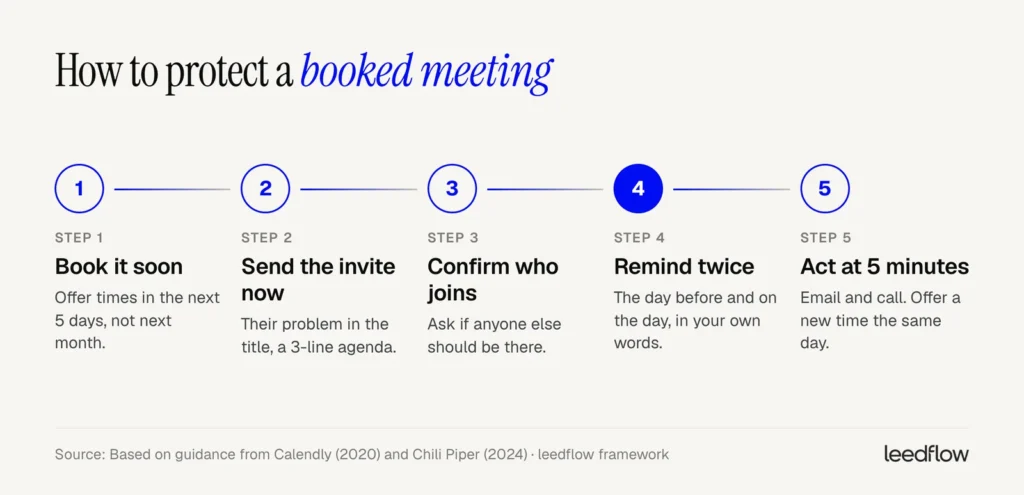
- Book it soon. Calendly suggests showing outbound prospects only the next 5 days.
- Send the invite yourself, right away. Their problem in the title, a three-line agenda in the body.
- Confirm who joins. Asking who else should be there brings the decision-maker in early.
- Remind twice, like a person. Aitken recommends the day before and on the day. Calendly suggests 24 hours and 4 hours ahead.
- Act at five minutes past. Email and call: “I’m on the line. Still good, or should we move it?” Then rebook the same day.
No-show rebook
Hi [First name],
Looks like today didn’t work out. No problem.
Would [day] at [time] or [day] at [time] suit you better? Same agenda: [one line].
[Your name]
Still getting no-shows? Check the purpose test. A prospect who never agreed to a clear purpose usually doesn’t show.
What to measure, and what to improve first
Your dashboard says meetings are up. Your pipeline says otherwise.
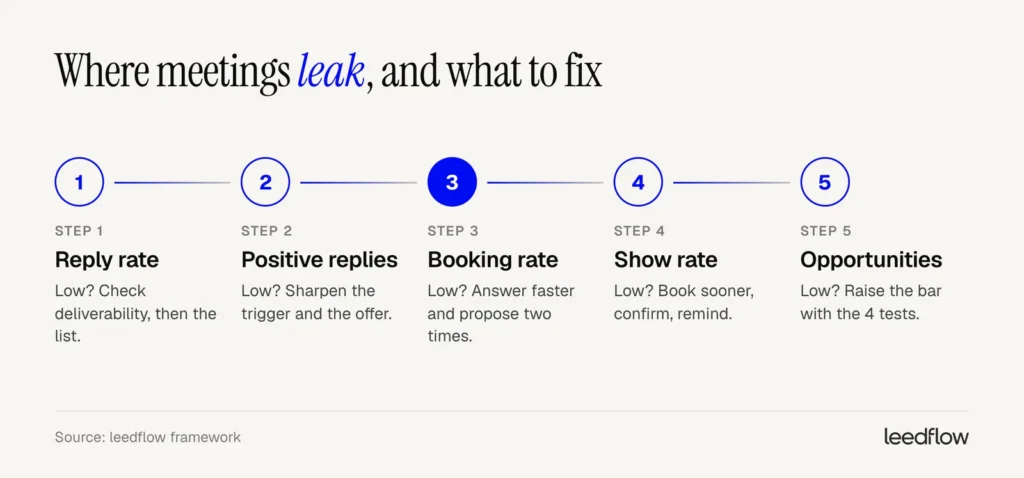
Usually the dashboard counts bookings and the pipeline counts outcomes. Track five rates as a chain to see where meetings leak.
| Metric | How to calculate |
|---|---|
| Reply rate | Replies ÷ prospects contacted |
| Positive reply rate | Interested replies ÷ all replies |
| Booking rate | Meetings booked ÷ interested replies |
| Show rate | Meetings held ÷ meetings booked |
| Meeting-to-opportunity rate | Qualified opportunities ÷ meetings held |
Meetings held = prospects × reply rate × positive reply rate × booking rate × show rate
Raise any one rate by a fifth and you hold a fifth more meetings from the same list. At the 3.43% average reply rate, 1,000 prospects give you about 34 replies. Every interested reply you fail to book is a prospect you already paid to reach.
Fix them in this order:
- Deliverability first. If bounces pass 2% or spam complaints climb, nothing else matters.
- Then booking and show rate. Process fixes you can make this week, on replies you already get.
- Then positive replies, with sharper triggers and offers.
- Then reply rate, with a tighter list.
- Then meeting-to-opportunity rate, by raising the bar on who you book.
Change one thing at a time and give it a couple of weeks. Then you know what moved the number.
Frequently asked questions
What is B2B appointment setting?
B2B appointment setting is booking first meetings between a seller and qualified prospects at other companies, usually by SDRs or an agency using email, phone and LinkedIn. The job is done when a qualified prospect attends and an account executive takes over.
How many meetings should an SDR book per month?
The Bridge Group’s 2025 report puts the median quota at 10 held meetings per SDR per month, down 40% since 2018. Most respondents were North American SaaS companies, so set your own from your meeting-to-opportunity rate.
Should you outsource appointment setting?
It can make sense when you need meetings fast and can’t hire SDRs yet. The catch: the agency learns which triggers and messages work, and that knowledge leaves with the contract. Pay for held meetings that pass an agreed quality bar, and ask for the reply data.
How long should a first sales meeting be?
We suggest 20 to 30 minutes: long enough to understand the problem and agree on a next step, short enough for a busy buyer to say yes. Save the full demo for the second meeting.
Automate prospecting with verified data and built-in exclusions
leedflow finds verified decision-makers among 400M+ contacts, blocks existing customers and duplicates across your team, and runs automated email and LinkedIn sequences in one place. Launch outreach in minutes, not days.