
Cold email no response? 5 reasons and how to fix each one in 2026
You sent 300 cold emails last week. Two people replied, and one of them asked to be removed.
That’s the classic cold email no response problem, and the first instinct is to rewrite the copy. Usually that’s the wrong place to start. This guide walks through the five usual causes in the order you should check them, with a symptom, a test you can run today, the fix and a before/after rewrite for each.
KEY TAKEAWAYS
- Check in this order: inbox, list, first lines, ask, follow-up. A problem higher up hides the ones below it.
- Test the inbox first. Send to your own Gmail and Outlook accounts and confirm SPF, DKIM and DMARC pass.
- Who you email matters more than when. Belkins saw 0.72% replies at 0–10-person companies and 0.22% at 10,000+ (2025).
- Ask for a one-line answer. In Gong’s data, an interest question beat a meeting request in cold emails.
- Follow up with something new. 42% to 59% of replies came after the first email, depending on the dataset.
Why do cold emails get no response?
Cold emails get no response for five common reasons: the email never reached the inbox, it reached the wrong people, the first lines didn’t show why this person should care, the ask was too big, or there was no useful follow-up. Check them in that order, because each problem hides the ones after it.
A sharp first line can’t work in a spam folder. A perfect ask can’t work on someone who doesn’t have the problem. So start at the top.
Read the replies you did get before you change anything. They point to the cause.
| What you see | Check first |
|---|---|
| Nothing at all, not even “no thanks” or “remove me” | Reason 1: the inbox |
| Bounces climbing, or “this person has left” auto-replies | Reasons 1 and 2: list quality |
| “Wrong person”, “not relevant”, “we don’t do that” | Reason 2: the list |
| A few replies, none from your best-fit accounts | Reason 3: the first lines |
| “What is this about?” or “Send me more info” | Reasons 3 and 4: relevance and the ask |
| Replies to email 1 only, then silence | Reason 5: the follow-up |
What’s a normal cold email response rate in 2026?
3.43% or 0.45%. Both are averages for cold emails sent in 2025, and both divide replies by emails sent.
The first comes from Instantly’s Cold Email Benchmark Report 2026, which averages campaigns across thousands of workspaces on its platform. Its top quartile reached 5.5%. The second comes from Belkins’ 2026 study: 34,393 replies to 7,530,489 emails from its own agency campaigns.
One caveat. Both are vendors reporting on their own senders, and neither is a controlled study. Different lists and offers, plus different ways of counting a campaign, can produce a gap that wide.
So don’t benchmark against the internet. Compare with your own last campaign to a similar list. If replies halved with the same audience, something broke, and one of the five reasons below will show you what.
Reason 1: your emails never reach the inbox
About 1 in 8. That’s how much marketing email missed the inbox in 2025. Validity’s 2026 Email Deliverability Benchmark measured 87.2% inbox placement worldwide, with 6.1% landing in spam and 6.6% going missing. At Microsoft (Outlook and Hotmail) the figure was 77.4%.
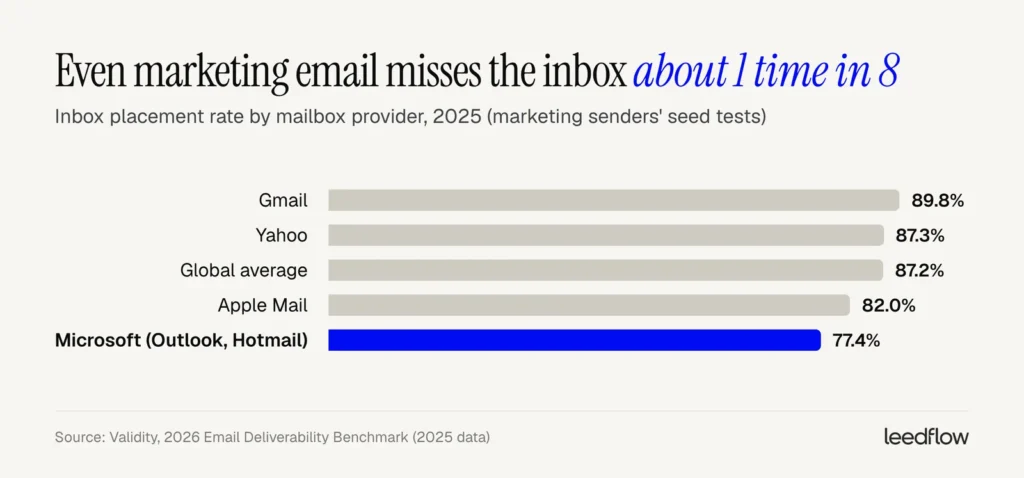
Validity’s numbers come from marketing senders’ seed tests. Cold email goes to people who never signed up, so don’t assume you do better.
Symptom. Silence. No “no thanks”, no “remove me”, nothing. Your sending tool says “delivered”, but that only means the receiving server accepted the message. It says nothing about which folder it went to.
How to check:
- Send the real campaign email to test accounts you own at Gmail and Outlook. If your buyers work at companies on Microsoft 365, test a company mailbox too. Note the folder it lands in.
- In Gmail, open the message, choose “Show original” and look for SPF, DKIM and DMARC. All three should say PASS.
- Check your bounce rate. Instantly’s benchmark says to keep it under 2%.
- If you send to Gmail addresses, set up Google Postmaster Tools to see your spam rate.
Gmail and Outlook.com publish hard rules for anyone sending 5,000 or more emails a day. Yahoo applies the same kind of rules to “bulk” senders and won’t say where bulk starts.
| Mailbox provider | What bulk senders need |
|---|---|
| Gmail (2024) | SPF, DKIM and DMARC, aligned with your From domain. Spam rate below 0.10%, never 0.30% or higher. One-click unsubscribe for marketing mail |
| Yahoo (2024) | SPF, DKIM and DMARC of at least p=none. Spam rate below 0.3%. Unsubscribes honoured within 2 days |
| Outlook.com (May 2025) | SPF and DKIM pass, DMARC of at least p=none, aligned. Failing mail is rejected with error “550; 5.7.515” |
These rules formally cover personal inboxes: Google’s page is about @gmail.com accounts, Microsoft’s about Outlook.com, Hotmail and Live. Many B2B buyers sit on Google Workspace or Microsoft 365, which filter on their own terms. Treat the table as the floor.
Even if you send far fewer than 5,000 a day, set it up. Google already requires SPF or DKIM from everyone sending to Gmail accounts, and DMARC takes an afternoon.
Fix:
- Authenticate the sending domain with SPF, DKIM and DMARC.
- Verify every address right before you send, and remove the ones that bounce.
- Ramp a new domain slowly. Instantly suggests 5 to 10 emails a day at first, rising over 4 to 6 weeks.
- Write like a person writes. Plain text, no images. One link at most, or none.
Reason 2: you’re emailing the wrong people
A reply comes in: “I think you want our IT team.” Another: “We’re a four-person agency, this isn’t for us.”
Those replies are a gift. Most people who don’t fit just stay silent, and you can’t tell their silence apart from a spam problem.
Who you email moves reply rates a long way. In Belkins’ 2025 data, reply rates ran from 0.72% at companies with 0–10 employees down to 0.22% at 10,000+. Founders and owners replied at 0.57%, VPs at 0.32%.
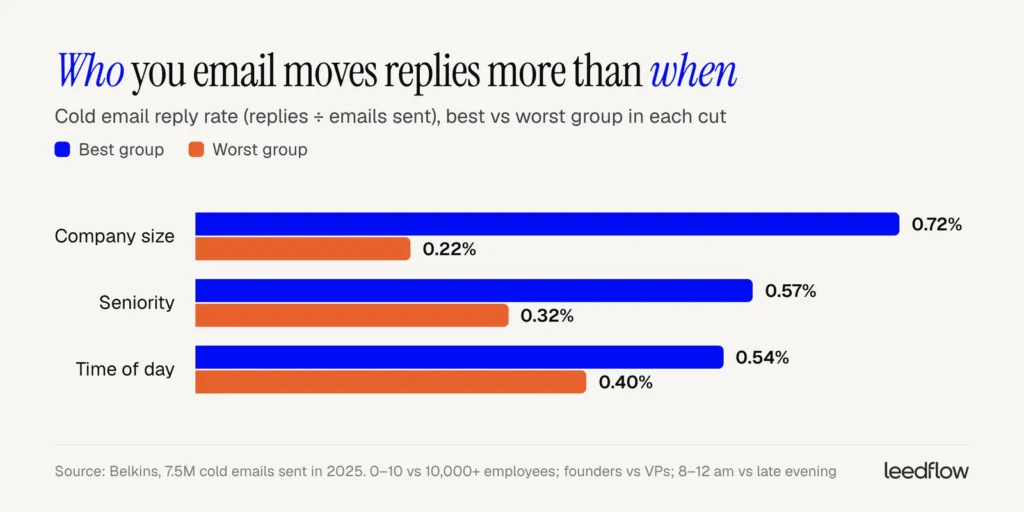
Belkins is an agency reporting on its own campaigns, so read it as direction. Use it to pick who gets your best effort.
Symptom. Wrong-person and not-relevant replies. Or silence from a list that passed the inbox test.
How to check: the 20-row audit. Export 20 random contacts from the campaign. For each one, answer yes or no:
- Does the company match your ideal customer profile (ICP): industry, size, market?
- Does this person own the problem you solve, or sit right next to it?
- Is the email address verified, and do they still work there?
If more than a handful of rows fail, fix the list before you touch the copy.
Fix:
- Write the ICP as filters you can actually apply: industry, headcount, country and the job titles that own the problem.
- Split the list by role. A Head of Sales and a CFO need different emails.
- Re-verify before each send. People change jobs, and last quarter’s export goes stale.
- Keep existing customers and open deals out.
In a B2B lead generation platform like leedflow, that list is one filtered search across 400M+ contacts with 60+ filters. Contacts are verified in real time, and a blocklist keeps existing customers out.
Reason 3: the first lines don’t say why them, why now
The email opens on a phone. The preview reads “Hi Anna, I hope this finds you well. My name is…” She’s already swiping.
The first two lines are all most people see before deciding. If they’re about you, the rest of the email doesn’t get read.
Symptom. The inbox test passes, the list is right, and your best-fit accounts still don’t answer. The few replies say “What is this about?”
How to check:
- The swap test. Replace the prospect’s company name with a competitor’s. If the email still works, it was written about you.
- The preview test. Read only what fits in a phone notification. Does it mention anything about them?
Fix. Open with something that’s only true for them right now, then name the problem it tends to cause. Good openers come from events: a hiring push, a new market, a new leader, a funding round.
You don’t need 10 minutes of research per prospect. Write one opener per segment around a shared trigger, and add a personal line only for your top accounts.
Before: about you
Subject: Quick question
Hi Anna,
I hope you’re well. I’m reaching out because [Your company] helps B2B companies grow their pipeline with better data and automation. We work with companies like yours and would love to show you how.
After: about them
Subject: SDR hiring in Göteborg
Hi Anna,
Saw that [Company] is hiring SDRs in Göteborg. New reps often spend their first weeks building lists instead of selling.
Is that on your radar, or already solved?
The subject and the first line could only go to her. The question takes one line to answer.
Reason 4: you ask for too much, too soon
“Do you have 30 minutes next week for a quick demo?”
To a stranger, that’s half an hour and a calendar check. All before they know whether you’re worth it. Most people answer by not answering.
Gong Labs analysed 304,174 sales emails (2020) and counted which ones led to a meeting within 10 days. In cold emails, an interest question (“Are you interested in learning more about X?”) was the best-performing call to action. Asking for a time did worse.
Symptom. Polite deferrals: “Send me more info”, “maybe later”. Or silence from people who fit and saw the email.
How to check. Count the asks. A case study link, a calendar link and “let me know your thoughts” is three. Count the words too: Instantly’s top performers averaged under 80 words in a first email.
Fix. End with one question they can answer in a line: yes or no, or this or that. Save the meeting request for the reply.
Before: three asks
Would you be open to a call next week to see a demo? Here’s my calendar: [link]. I’ve also attached our case study.
After: one easy question
Worth a short conversation, or not a priority this quarter?
Once they say yes, switch: propose two specific times.
Reason 5: one email, then silence
58% or 41.4%. That’s the share of replies that came from the first email in two 2025 datasets: Instantly’s benchmark and Belkins’ follow-up study of 7.5 million emails.
Either way, four to six in ten replies arrived after email one. Stop after one email and you give away close to half of them, or more.
The two sources disagree on length as well. Instantly recommends 4 to 7 touchpoints. Belkins calls 3 to 5 steps the sweet spot and sees diminishing returns after step 5. We’d start with four emails spaced 3 to 4 days apart, as Instantly suggests, and only go longer if the later steps still earn replies.
Symptom. Replies come only from email 1. Or the follow-ups read “just bumping this”, and the “remove me” replies climb.
How to check. Look at replies by step in your sending tool. If steps 2 to 4 bring nothing, read them back to back. They probably say the same thing three times.
Fix. Give each follow-up one new reason to reply: a different angle, a short proof point, something useful, or a polite close (“Should I stop here?”).
Before: the bump
Hi Anna, just bumping this to the top of your inbox. Any thoughts?
After: a new angle
Hi Anna, a different angle: new reps often lose their first weeks to list building. I put together a short checklist for that. Want me to send it?
If LinkedIn is part of your outreach, leedflow runs automated email and LinkedIn sequences with conditional logic, so you set what happens next based on what the prospect did.
Send time matters less than most people think. In the Belkins data above, the best time of day beat the worst by 0.14 percentage points. Company size moved it by 0.50. Pick a weekday morning in their time zone and put the saved energy into the list.
What should you fix first?
Two changes at once, and you’ll never know which one worked.
Copy this cold email no response check into your campaign notes, work down it and stop at the first “no”. Fix that, relaunch to a fresh slice of the same list, and compare with your previous campaign.
Cold email no-response check
Inbox: do test emails land in the inbox at [Gmail / Outlook / Microsoft 365]? Do SPF, DKIM and DMARC pass? Is the bounce rate under 2%?
List: how many of 20 sampled contacts fit the ICP and own the problem? [answer]
First lines: would the opening still work with a competitor’s name in it? [yes / no]
Ask: one question, answerable in one line? [yes / no]
Follow-up: does each step add something new? Replies by step: [step 1] [step 2] [step 3] [step 4]
Next test: [the one change], judged on [number] prospects who finish the sequence
Frequently asked questions
Should you send cold email from a separate domain?
A separate sending domain, such as a close variation of your main one, keeps a deliverability problem away from your company’s everyday email. We’d use one once you send at any real volume. Authenticate it with SPF, DKIM and DMARC like your main domain, point it to your website, and ramp up slowly.
Do open rates still tell you anything?
Very little. Apple’s Mail Privacy Protection prevents senders from seeing whether an email was opened, and Belkins’ 2026 study now divides replies by emails sent instead of by opens. Judge a campaign on replies, bounces and your own inbox tests.
How many cold emails can you send per day?
Start low on a new domain. Instantly’s 2026 report suggests 5 to 10 emails a day at first, rising over 4 to 6 weeks. Above 5,000 a day to Gmail or Outlook.com addresses, the bulk-sender rules apply in full. Extra volume multiplies whatever is broken, including a reply problem.
How long should you wait before judging a campaign?
Wait until a few hundred prospects have finished the whole sequence. When reply rates sit at a few percent or less, a smaller sample swings on one or two replies. Then compare the result with your own previous campaign to a similar list.
Start with a list that fits
Leedflow finds verified decision-makers among 400M+ contacts with 60+ filters and runs automated email and LinkedIn sequences with conditional logic.